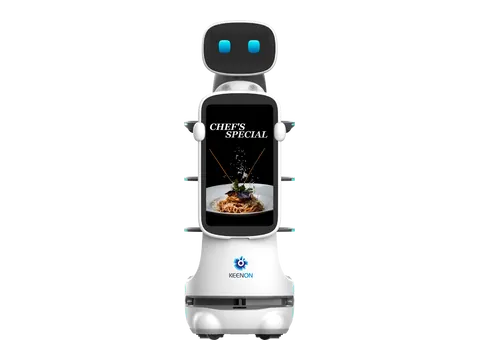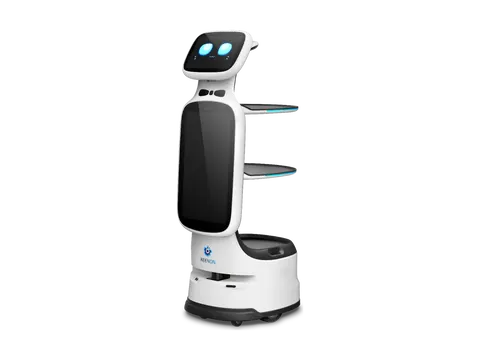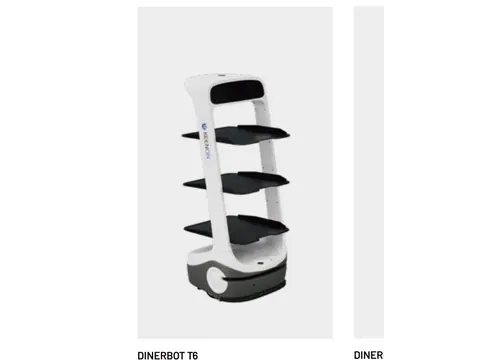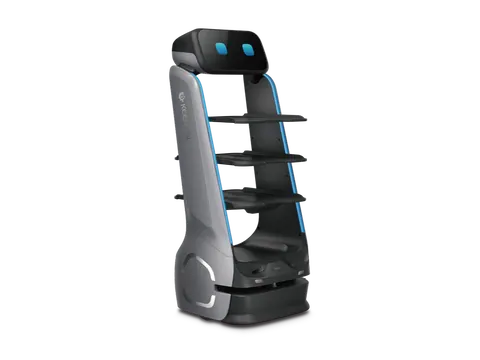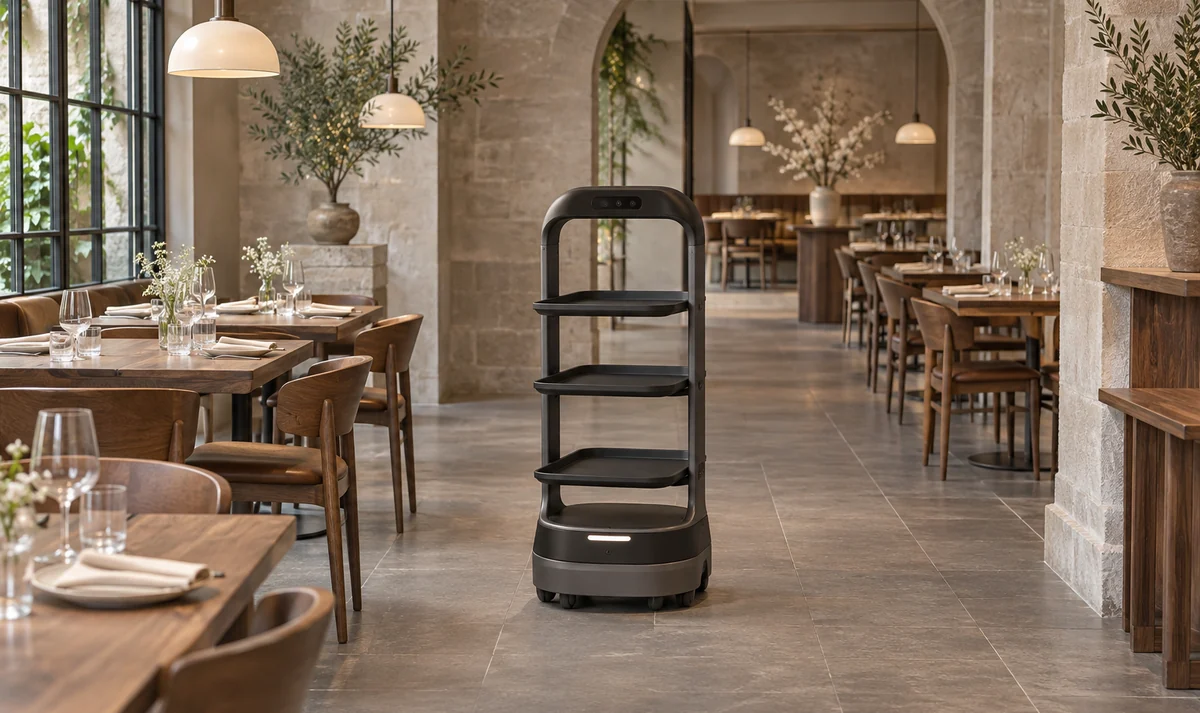
DINERBOT T11 lists a 490 mm minimum passage, T8 550 mm, T10 590 mm and T9 700 mm. Check those numbers after customers pull their chairs back. When several models still fit, load the real trays and time a full departure, handover and return. The heaviest dish may decide which shelf can be used.
Mark the occupied aisle before choosing a robot
Work through the route at seat-back height with the furniture in its service position. For a worked example, two tables have an 850 mm gap edge to edge. One occupied chair projects 140 mm and the other 130 mm. The usable gap falls to 580 mm before anyone stands up. On paper that clears the quoted T8 minimum by 30 mm and falls 10 mm short of the T10 figure. A small clearance like that tells you where to run the first controlled trial. The turning and passing space still has to work with the trays loaded.
Repeat the measurement at the legs and feet, at the horizontal shelf that might overhang, and at the height of the robot’s sensors. A coat hanging on the aisle side or a menu stand can make a different level the pinch point. Put the occupied chairs in the positions people use during the second sitting. Note where an employee can pass safely and where the robot has to hold back. Give waiting points their own dimensions so an extended pause does not create a queue into the kitchen.
Check the entry and exit of the ninety-degree approach to the kitchen pass. A robot that clears two straight segments can still pause where its corner has to swing into an occupied table. Mark the arc on the floor from a slow loaded pass. Study the return trip separately with dirty dishes aboard and staff crossing the other way. Use the applicable site rules for circulation and exits and agree the traffic plan with the venue before a live service run.
Published KEENON figures
| Model | Total payload | Per level | Minimum passage | Body width | Listed runtime | Manufacturer sources |
|---|---|---|---|---|---|---|
| DINERBOT T3 | 40 kg | — | 750 mm | 496 mm | ≤12 h | product data |
| DINERBOT T8 | 20 kg | — | 550 mm | 384 mm | ≤15 h | product data |
| DINERBOT T9 | 40 kg | — | 700 mm | 500 mm | ≤18 h | product data |
| DINERBOT T9 Pro | 40 kg | 10 kg | — | 500 mm | 12–15 h | PDF 18 · PDF 7 |
| DINERBOT T10 | 40 kg | — | 590 mm | 486 mm | 9–12.5 h | product data |
| DINERBOT T11 | 20 kg | 5 kg (middle) / 10 kg (bottom) | 490 mm | 463 mm | ≤13.5 h | product data |
These are the field values in the catalogue. A dash means the figure is absent from that record. The T9 Pro’s 500 mm is body width. Obtain its occupied passage and turning clearance for the delivered setup. A T9 passage measurement is for the T9. Use the T10 versus T9 Pro comparison to put their loads, dimensions and source documents on the same page.
Allocate the trays before weighing the load
Start at the pass with the menu the venue actually sells. Weigh plates, bowls, bottle, covers and serving tray together. Put loaded dimensions and collection height on the order card. The widest part of a platter can clear the shelf opening with the body stationary and still project into the turn. Staff need room to slide the plate out without shifting another customer’s drinks. Get the count of fitted levels and the limit on each in writing.
KEENON’s T9 Pro brochure shows three instrumented trays. Its manual lists 10 kg per level, and the brochure table gives 40 kg total. If the supplied setup has three usable levels at 10 kg each, the per-level arithmetic yields a 30 kg working ceiling for that layout, subject to the manual and load distribution. A 12 kg tray exceeds the individual level rating even if the whole load is below 30 kg. KEENON’s T9 product page also lists 10 kg per level. Verify the offered shelf count and the plate-clearance setting before assuming that two T9 versions load the same way. KEENON T9 Pro brochure, KEENON DINERBOT T9 product page
For T11, place an example 7 kg serving on the bottom tray with its 10 kg limit. The middle tray is rated 5 kg. Check the published 20 kg maximum against the combined weight, then measure whether the cover can be lifted away at the chosen height. T3 brings enclosed shelves and powered doors into the assessment. Verify the doors open at the pass and at handover, and make sure staff have space to stand in front of the robot when unloading. The supplier’s brochure lists the individual shelf arrangement so it can be checked against what is delivered. KEENON product brochure
Test liquid transport at working speed
Bring the usual soup bowl, plate and lid. Start with a cold equivalent filled to the normal level. Mark its position on the tray and repeat with the same loading across models. Go through the floor joint at the kitchen door, enter the tight turn, approach the table, then perform an ordinary stop when the test path is obstructed. Inspect liquid outside the bowl and how far the bowl moved. Repeat with other trays loaded because the effect can differ by height and mass distribution.
KEENON describes a shock-absorbing chassis and offers a floating tray accessory for T8. Include the exact proposed tray in the trial. Record speed, acceleration settings the supplier is permitted to adjust, fill level and which run spilled. Change one setting at a time. Before serving an actual hot order, agree the acceptable condition with the kitchen and whom a server calls if the robot stops in the corridor. KEENON DINERBOT T8 product page
Choose the candidate by bottleneck
For a narrow route, set up T8 and T11 on the same floor and compare useful trips, including how many orders have to be split. When dispatch batches are larger, try T9, T9 Pro or T10 where the measured lane and turning space can carry the appropriate configuration. Start a return run with the staff member at the pass and another serving nearby. Test whether the unit can unload, leave the table and return without making staff walk farther or move other orders out of the way.
If the dining room also expects a screen to greet customers, set up the intended message at the actual waiting point. Measure whether it encourages people to stop where the robot needs to turn. Quote the screen and service function in the requested configuration. If PUDU is already on your list, take the same taped aisle and tray loading to the T10 versus BellaBot Pro trial.
Keep the trial inside a real service window
Set the clock from an accepted order at the pass to the point the robot is ready to take another one. Log the number of correctly delivered trays, people who intervened, minutes waiting for space and any spills or split orders. Try one long service with the battery at the state operators normally begin with. Leave enough time to perform the cleaning and charging procedure with the staff who will close the room. Include missed table signals and give every interrupted run a result in the log.
At the final handover, repeat one delivery with a server who missed the supplier’s demonstration. Ask them to stage the next order, recognise which table to serve, and clear an interrupted trip. Time what happens when the restaurant changes the table layout for a group booking. Agree who can modify the route and who checks the clearances again before putting it back into use.
Send the occupied floor plan, table positions, typical loads and cycle target with a quote request. The KEENON brand page lists trial scenarios and the dining robot category provides alternatives for the same route.
Buyer questions
Can a robot rated for 590 mm run a 590 mm measured aisle?
Use the stated passage for initial screening. Confirm the occupied clearance and turning path at the proposed speed with the fitted trays and agree the conditions that keep the route clear.
How many trays can I load to the maximum?
Use the delivered tray count and rating for each level, plus the total limit. Weigh dishes and serving hardware. The lowest applicable limit controls the load at each position.
How should I include charging in the comparison?
Use the published charging condition for each model and measure how much battery the service actually uses. Check where a mid-shift charge would fit without blocking dispatch or reducing service capacity.

 KEENON Robotics